Position Sizing
Position sizing is the process of determining how much capital to allocate to each individual trade. It balances profit potential against the risk of losing your trading account.
In depth
Position sizing is the cornerstone of professional trading risk management. Most new traders focus entirely on finding winning trades. They ignore the equally critical question: how much should I risk on this trade? Position sizing answers that question with precision and discipline.
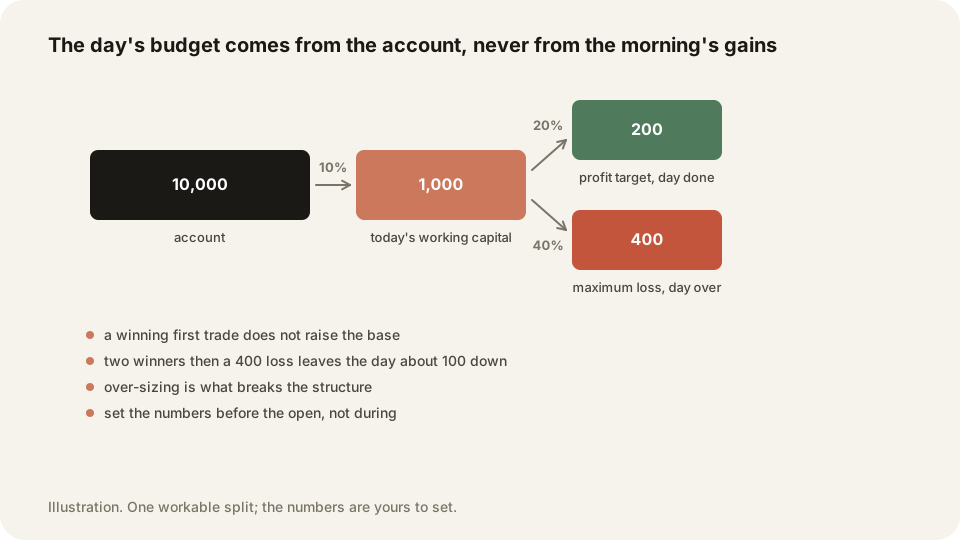
At its core, position sizing means calculating the number of shares, contracts, or units you'll trade. This calculation depends on three factors: your account size, your risk tolerance, and your stop loss distance. For example, a trader with a $10,000 account might risk only $100 per trade, or 1% of their capital. If their stop loss is 50 pips away, they'd calculate: $100 divided by 50 pips equals 2 units per trade.
The most common position sizing method is the percentage risk model. Traders decide what percentage of their account they're willing to lose on any single trade. Conservative traders risk 0.5% to 1% per trade. Aggressive traders might risk 2% to 3%. This approach protects your account during inevitable losing streaks. If you lose ten trades in a row risking only 1%, your $10,000 account becomes $9,044. You're still solvent and can recover. If you risk 10% per trade and lose ten in a row, your account is nearly wiped out.
Another critical position sizing concept is the risk-to-reward ratio. This compares how much you're risking to how much you expect to gain. A 1:2 ratio means risking $100 to potentially make $200. A 1:3 ratio means risking $100 for $300 in profit. Better ratios require disciplined trade selection. You can't use a 1:3 ratio if your stop loss is too close to your entry. The market structure must support your position sizing strategy.
Position size scaling is an advanced technique used by experienced traders. Rather than trading the same number of contracts every time, they adjust size based on market conditions. When volatility is low and they have high confidence, they trade larger. When volatility spikes or they're uncertain, they trade smaller. This requires sophisticated analysis and strict discipline. Most beginning traders should use fixed position sizing until they develop advanced skills.
The Kelly Criterion is a mathematical formula for optimal position sizing. It calculates the percentage of your account to risk based on your win rate and average winning versus losing trade size. The formula is: (wins percent × average win) minus (loss percent × average loss) divided by average win. This produces a theoretical optimal position size. However, many traders use half-Kelly or quarter-Kelly because full Kelly sizing can be psychologically brutal during drawdowns.
Undersizing positions is common among traders with low confidence. They might risk 0.2% per trade, treating trading like a lottery with minimal stakes. This approach eliminates meaningful losses but also prevents meaningful gains. Over 100 trades, proper position sizing compounds your results significantly. Undersized positions don't create wealth; they create frustration and early quitting.
Oversizing is the more dangerous mistake. A trader with a $5,000 account risks $500 per trade, or 10%. After three bad trades, they've lost $1,500, or 30% of their capital. They're now panicked and trading emotionally. Their decision-making deteriorates, leading to more losses. This vicious cycle ends accounts far too quickly. Position sizing discipline prevents this catastrophe from happening.
Position sizing changes as your account grows. A $50,000 account should not trade the same shares as a $5,000 account. Proper scaling maintains your risk percentage as wealth increases. If you risked $100 on 1% of $10,000, you'd risk $500 on 1% of $50,000. This keeps your psychological and financial risk constant while allowing profit growth. Traders who forget to scale often revert to old habits and lose bigger amounts in dollar terms.
Currency traders, stock traders, and futures traders each apply position sizing differently. Currency traders work with pip values and lot sizes. Stock traders count shares. Futures traders count contracts. The underlying principle remains identical: calculate position size based on your dollar risk tolerance, not arbitrary share counts. A trader might trade 50 shares of one stock and 200 shares of another, depending on volatility and stop loss distance. The dollar risk should remain constant.
Position sizing forces traders to make hard choices about trade selection. If your position sizing model says you can only risk $100 per trade, you won't enter every signal. You'll filter for high-quality setups. This selectivity improves overall profitability dramatically. Fewer, higher-probability trades beat more frequent low-probability trades every time. Position sizing creates the discipline to wait for the best opportunities.
Why it matters
Position sizing is the difference between sustainable trading and account blowups. New traders often ignore it because they focus on accuracy. They think winning 60% of trades guarantees profit. But if those trades are sized incorrectly, even a 60% win rate destroys accounts. A trader winning 60% while risking 5% per trade will eventually wipe out. The same trader winning 50% while risking 1% per trade stays profitable long-term.
Your position size determines your ability to survive losing streaks. Professional traders expect seven to ten consecutive losses regularly. With 1% risk per trade, a ten-loss streak costs 10% of your account, recoverable through three good trades. With 5% risk, the same streak costs 50%, requiring a 100% gain to recover. Mathematics and probability heavily favor disciplined position sizing. It's not just about making money; it's about staying in the game long enough to make money.
Position sizing eliminates emotional decision-making during losses. When you follow a mechanical position sizing rule, you remove the temptation to revenge trade. After a bad trade, you can't suddenly risk 5% to make back that loss. Your position sizing rule says risk 1%, so you risk 1%. This discipline prevents the cascade of losses that destroys undisciplined traders. It transforms trading from an emotional rollercoaster into a systematic business operation.
TraderLog's trading journal automatically calculates position sizing for every trade you log. When you enter your entry price, stop loss, and share count, TraderLog computes your dollar risk instantly. You see immediately whether you followed your position sizing rules. This real-time feedback trains discipline over time. Traders who track position sizing become more consistent and profitable than those who don't. Over months of journaling, you'll see clear patterns in your best-performing position sizes and market conditions.
The platform's analytics reveal how position sizing correlates with your profitability. You can filter trades by position size category and see win rates and risk-reward ratios. Maybe your 1% risk trades have a 65% win rate, while 3% risk trades drop to 45%. TraderLog visualizes this data so you understand your optimal sizing. Many traders discover they're better off trading smaller but more frequently. Others find larger, less frequent positions work best. Your personal trading data should drive this decision.
TraderLog's position sizing calculator tool helps you determine correct entry quantities before you trade. Input your account size, risk percentage, and stop loss distance, then receive exact share counts. This removes calculation errors that lead to over or undersizing. The tool works across stocks, forex, and futures. You can save multiple position sizing profiles for different markets or trading styles. Over time, TraderLog becomes your position sizing command center, eliminating guesswork and enforcing mathematical discipline.
Frequently asked questions
Most professional trading educators recommend 1% to 2% risk per trade for beginners. Starting with 1% allows you to survive a ten-trade losing streak while losing only 10% of your account. As you gain experience and prove consistent profitability, you can increase to 1.5% or 2%. Never exceed 2% per trade unless you have five years of consistent, verified trading results. The goal is longevity before aggression.
Don't enter the trade until you know your stop loss. Position sizing and stop loss distance are inseparable. If you enter first and add stops later, you're already making emotional decisions. Proper methodology: identify the setup, determine where stops logically go based on chart structure, calculate position size from risk tolerance and stop distance, then enter. This sequence maintains discipline.
Yes, for the first year of trading. Fixed position sizing creates consistency and prevents emotional variation. After one year of profitable trading data, you can experiment with scaling. Some traders increase size on high-confidence setups or after winning streaks. Advanced traders reduce size during market uncertainty. But fixed sizing teaches risk discipline first. Master the basics before advanced variations.
You will eventually lose your trading account. It's not a matter of if, but when. Even traders with 70% win rates blow accounts by ignoring position sizing. The math is inevitable. Large drawdowns compound losses, requiring increasingly difficult percentage gains to recover. Most traders quit before recovery. Position sizing discipline is literally the difference between success and failure.
Scale your dollar risk, not your share count. If you risked $100 on a $10,000 account (1%), risk $200 on a $20,000 account. Your share count will increase naturally because the same dollar risk applies to your larger account. This keeps psychological pressure constant. Many traders forget to scale and suddenly find themselves risking larger dollar amounts on the same number of shares, which is dangerous.
Track Position Sizing in your trading journal.
TraderLog calculates Position Sizing automatically across your trade history, and shows you exactly when and why it changes.