Glossary

Stop Loss Order

A stop loss order is an instruction to automatically sell a security when its price falls to a specified level. It protects traders from excessive losses by triggering an exit at a predetermined price.

In depth

A stop loss order is a fundamental risk management tool that every serious trader should understand and implement. At its core, a stop loss order instructs your broker to automatically sell your position when the asset's price drops to a specific level you've chosen in advance. This level is called the stop price or trigger price. Once the market price touches or falls below this stop price, your order converts into a market order and executes immediately at the next available price.

The mechanics are straightforward but powerful. Let's say you buy 100 shares of ABC Stock at $50 per share. You're confident in the trade, but you want to protect yourself from major losses. You place a stop loss order at $45. If the stock price drops to $45, your order automatically triggers and sells your 100 shares at the market price, which might be $44.95 or $45.02 depending on market conditions. Your maximum loss is capped at approximately $500 plus any trading costs. Without this stop loss order, you might hold the stock all the way down to $30, losing $2,000 instead.

There are several types of stop loss orders to understand. The most common is a simple stop loss order, also called a stop market order. When triggered, it becomes a market order that executes at the best available price. Another type is the stop limit order, which combines a stop loss trigger with a price limit. With a stop limit order at $45 with a limit of $44.50, your order triggers at $45 but will only execute if the price is $44.50 or better. This protects you from selling at terrible prices but risks not executing at all if the stock gaps down dramatically.

Trail stop loss orders add another dimension to risk management. Instead of a fixed price, you set a percentage or dollar amount below the current market price. If you own a stock trading at $100 and set a 10% trailing stop, your stop price sits at $90. As the stock rises to $110, your stop price automatically adjusts upward to $99. Your stop loss order essentially follows the price upward, protecting profits while allowing for continued gains. This technique is particularly valuable in trending markets where you want to ride momentum while limiting downside risk.

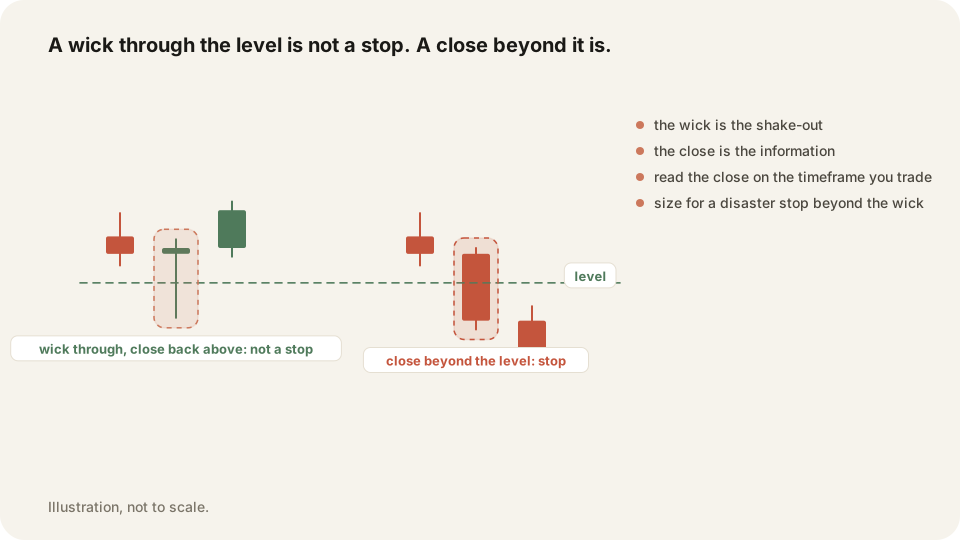
The timing and placement of your stop loss order requires strategic thinking. Placing your stop too close to your entry price means you'll get stopped out by normal market volatility, locking in losses before the trade has time to work. Placing it too far away defeats the purpose because you're accepting larger losses than necessary. Most professional traders use technical analysis to place stops at meaningful support levels or below recent swing lows. This approach means your stop has a higher probability of staying intact while providing genuine protection.

Psychological factors make stop loss orders invaluable. Many traders struggle with the emotional discipline to sell losing positions. Fear, hope, and stubborn attachment to being right prevent them from cutting losses at predetermined levels. By setting a stop loss order before entering a trade, you remove emotion from the exit decision. Your exit plan is made during the logical planning phase, not during the stressful execution phase when losses are visible. This behavioral protection is worth as much as the financial protection the stop loss provides.

One critical concept is the difference between a stop loss order and actually reducing your risk. A stop loss order doesn't reduce your risk; it controls it. The risk still exists. If you buy stock at $50 with a stop loss at $45, you're risking $5 per share or $500 on 100 shares. The stop loss simply ensures that if you're wrong, your actual loss won't exceed that predetermined amount. Understanding this distinction prevents traders from becoming overconfident just because they've placed a stop loss order.

Real-world scenarios highlight stop loss effectiveness. During the 2020 COVID crash, traders with stop loss orders exited positions with 15-25% losses. Those without stops watched their portfolios decline 40-60% before recovery months later. The traders with stops preserved capital and could redeploy it into better opportunities. Similarly, in individual stock situations where negative news breaks, traders with stops exit near current prices while those watching might sell at 20-30% discounts to where the stop would have triggered.

Stop loss orders have limitations worth acknowledging. In fast-moving markets or during gaps at market open, your stop loss might execute at a significantly worse price than your stop level, called slippage. During a market crash, a stock might gap down $5 below your $45 stop, executing at $40 instead. Also, some brokers charge fees for stop loss orders, though this is increasingly rare. Finally, in highly illiquid securities, there might not be a buyer at your stop price, causing execution delays.

Why it matters

Stop loss orders are the foundation of professional risk management. Without them, a single bad trade or unexpected market event can wipe out months of profits and significantly damage your trading account. Even excellent traders with 60% win rates still lose on individual trades. The difference between amateur traders and professionals isn't accuracy; it's how much they lose when they're wrong. Professional traders limit losses to 1-2% of their account per trade. Amateur traders often lose 5-10% on bad trades because they lack stop loss discipline. Over 10 trades, this difference compounds dramatically. A trader with 50% accuracy but 1% losses per trade and 3% gains per winner will profit significantly over time. A trader with 50% accuracy but 5% losses and 3% gains will eventually go broke.

Stop loss orders also improve your trading psychology in subtle but important ways. When you know your maximum loss is predetermined, you trade with confidence instead of fear. You can focus on identifying good setups instead of monitoring positions obsessively, hoping they work out. This psychological benefit reduces trading stress and helps you stick to your trading plan. Traders who skip stop losses often make revenge trades after losses, trying to immediately recoup losses with riskier positions. This chase behavior typically results in even larger losses. Stop loss orders short-circuit this destructive pattern.

From a portfolio perspective, stop loss orders protect your overall wealth accumulation. Compound returns work both directions. A $10,000 account declining to $9,000 needs a 11% gain just to break even, not the 10% you might think. Decline it to $8,000 and you need 25% gains. Decline it to $5,000 and you need 100% gains. By stopping losses at predetermined levels, you avoid these deep drawdowns that require massive gains to recover from. Your account stays healthier and compounds more effectively over years and decades of trading.

How TraderLog tracks this

TraderLog's journal system makes implementing stop loss orders systematic and trackable. In the TraderLog platform, you can record your stop loss level when you enter each trade, creating an accountability mechanism. The journal captures whether you actually used a stop loss, at what price you placed it, and whether the order triggered. Over time, you can analyze patterns in your stop loss placement. Did stops placed at support levels work better than those placed at arbitrary percentages? This data analysis helps you refine your stop loss strategy. You can compare your profitability when using stops versus when you skipped them.

The platform's trade metrics help you understand your risk-reward ratios. For each trade, you can see the distance between your entry and stop loss, and compare it to your target profit level. Ideally, you want your potential gain to exceed your potential loss by at least 2:1. If you're risking $500 to make $500, that trade needs 67% accuracy to break even after costs. But if you're risking $500 to make $1,500, you only need 33% accuracy. TraderLog helps you track these ratios so you can see if you're consistently maintaining good risk-reward parameters.

TraderLog's analysis features let you examine slippage patterns and order execution quality. When you record your stop loss price and actual exit price, the platform tracks the difference. Over time, you can see if certain market conditions, brokers, or times of day produce worse slippage. This data helps you adjust your stops or trade timing. If you consistently experience 0.5% slippage at market open, you might place stops 0.5% wider to account for this, or trade later in the session. The goal is continuous improvement in how you implement this critical risk management tool.

Frequently asked questions

Your stop loss order will trigger, but it executes at the next available market price, which might be significantly below your stop price. This is called slippage. During extreme volatility or market opens, a stock might gap down $5 below your stop, executing at that lower price. This risk is why many traders place stops slightly wider than their pure risk tolerance to account for potential gaps.

Stop loss orders (market orders) execute faster and guarantee you exit when triggered, but might execute at poor prices. Stop limit orders guarantee a price but risk not executing at all. For volatile stocks or large positions, use stop loss orders. For stable positions where execution price matters less, consider stop limit orders. Many traders use both depending on the situation.

There's no universal best percentage; it depends on your strategy and volatility. Day traders often use 1-3% stops because stocks move fast. Swing traders might use 5-8% stops. Position traders might use 10-15% stops. Use the volatility of the stock you're trading. A stock that naturally swings 3% daily should have a stop beyond 3%, perhaps 5%, to avoid whipsaws.

Yes, most exchanges and brokers support stop loss orders on cryptocurrencies and forex pairs. However, execution during extreme volatility might differ. Crypto markets are 24/7, so your stops work around the clock. Forex markets have different sessions with varying liquidity. Always verify your specific broker's stop loss functionality for these asset classes.

Most modern brokers don't charge fees for placing stop loss orders. However, you'll pay standard trading commissions when the stop loss actually executes and your position closes. Always check your broker's fee schedule. Some brokers might charge slightly higher commissions during market volatility or for certain order types, but this is increasingly rare.

Track Stop Loss Order in your trading journal.

TraderLog calculates Stop Loss Order automatically across your trade history, and shows you exactly when and why it changes.