The day's budget is set before the open and does not move
You were up 300 by 10 a.m., so the afternoon felt free. It was not, and the giveback landed in the same session. A fixed daily budget stops the arithmetic from drifting.
The morning's profit becomes the afternoon's excuse
By 10:05 you are up 300 dollars and the day feels solved. At 10:40 you take a position twice your usual size, because the morning's money is not really yours yet. You finish the session down 400.
The mechanical cause is the base you sized from. You computed the morning's risk off the account. Then you computed the afternoon's risk off the account plus the morning. The second number is bigger, so every position after it is bigger.
The first real loss then takes back more than one winner made. None of that requires you to be undisciplined. It is arithmetic with a moving denominator, and the denominator only moves up. It moves on the days you are winning, which are the days you feel most willing to push.
A daily budget is one number, decided before the open, that ignores how the morning went.
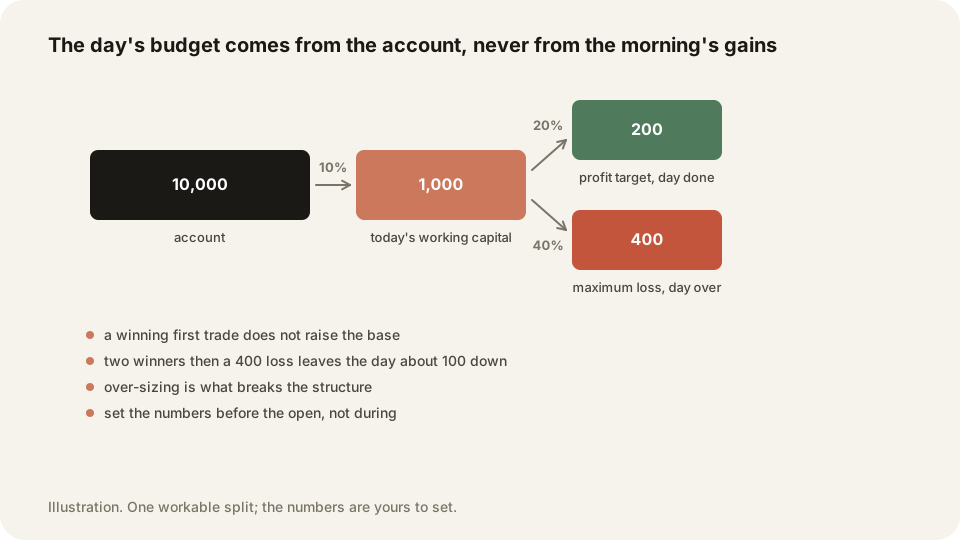
One split that works: 10 percent out, 20 up, 40 down
Take 10 percent of the account as the day's working capital. Set the profit target at 20 percent of that slice. Set the maximum loss at 40 percent of that slice. Reach it and the day is over, including the setup you are sure about.
On a 10,000 dollar account: working capital 1,000, target 200, maximum loss 400. On 25,000: working capital 2,500, target 500, maximum loss 1,000.
The asymmetry is deliberate. You are allowed to lose twice what you are trying to make. That sounds backwards until you look at a bad week. Two full stop-out days back to back on the 10,000 account cost 800, or 8 percent.
Painful, survivable, and you are still trading on Wednesday. Nothing here needs a large account. Scale the percentages to whatever you have and the structure holds.
The numbers on two account sizes
Nothing below is a survey result. Each row is one multiplication, and you can redo it on your own balance in ten seconds.
Two things to notice. The maximum loss is twice the target, so a single bad day cancels two good ones and no more. And the working capital is the amount you are willing to have deployed. The amount you are willing to lose is a different number.
Start at a quarter of the budget and add only on structure
Your first entry uses a quarter to a third of the day's working capital. On the 10,000 account that is 250 to 333 dollars of premium. For a short-dated contract, that is very few of them. The small starter is the point.
You add when the chart validates the idea. Price took the level and held above it, or the swing high you needed actually broke. You do not add because the position is green. Those two feel identical at the time, and only one of them is information.
Two rules keep the adds honest. Added size never pushes total risk past the day's maximum loss. And the stop for the whole position moves to one level, so you never hold two opinions in one ticker.
When the target is hit before lunch, closing the platform is a legitimate answer. Nobody pays extra for screen time.
Set the day's numbers before the open
Do this while the market is closed, on paper or in your journal. Each number is one multiplication. Having them written removes the argument you would otherwise have at 11 a.m.
- Write today's account balance, before any open positions
- Multiply by 10 percent for the day's working capital
- Multiply the slice by 20 percent for the profit target
- Multiply the slice by 40 percent for the maximum loss
- Divide the slice by four to get a starter position size
- Keep all five numbers visible while you are trading
- Log every fill against the running total during the session
- Stop the moment the maximum loss is reached
- Keep the same base tomorrow unless the balance itself changed
- At the weekend, count the days that ended on the loss limit
Frequently asked questions
No. Recompute the base from the account balance, and only once the balance itself has changed. Sizing off intraday profit is how one afternoon takes back a week.
It is 40 percent of the day's slice, which works out at 4 percent of the account. Cut the working capital to 5 percent if the dollar figure stops you following your stops.
Stop, or trade the rest of the session at reduced size with the target already banked. The number only means something if reaching it changes what you do.
Size the day with TraderLog's free calculators
The position size calculator turns an account number and a stop into a share count. The max drawdown calculator shows what a bad run costs. Then the journal's calendar keeps every day's P&L from your broker sync in one grid.
Every trading morning at 8:40 ET our model draws the SPY, QQQ and IWM zones it expects to matter, on a TradingView chart, before the open. Where price reaches one, it has turned 74 percent of the time. Free, no account. See today's map