Naming the phase only helps if it changes the trade
You called accumulation on sight and then bought the middle of it anyway. A label with no instruction attached is decoration. Here is the instruction for each of the four.
You named the phase and then traded it anyway
You watched a 45 minute range, called it accumulation out loud, and bought the middle of it. The last candle looked strong. It was the fourth strong-looking candle inside the same range.
The label did nothing because it carried no instruction. Phases earn their keep only when each one sends you somewhere different, and these four do.
The cost lands hardest on short-dated options. Sitting in a range on same-day expiry means decay charges rent while price goes nowhere. You can be right about the eventual direction and still hand back most of the premium waiting for it.
The other half of the cost is your stop. In one phase, a wick through your level is expected and you stay in. In another, the same wick says the move is finished. Same candle, opposite instruction, and the phase is the only thing separating them.
Accumulation: draw the box and let it break without you
Accumulation is a sideways range where both sides are building positions. Your job inside it is preparation.
Draw the box. Two touch points across the top and two underneath, wicks or bodies, and nothing more. Collecting a fifth touch does not improve the box, it just makes you late. Copy the box forward to the right and leave it there.
Then wait for a close outside it. The break is the trade, and the target is one box width from the edge that broke. A range fills back in like a magnet. Asking for more than the width is asking the market for a favour.
On same-day expiry, holding through a range is the aggressive choice. There is no structure to be right about yet, and the clock is the only thing still moving.
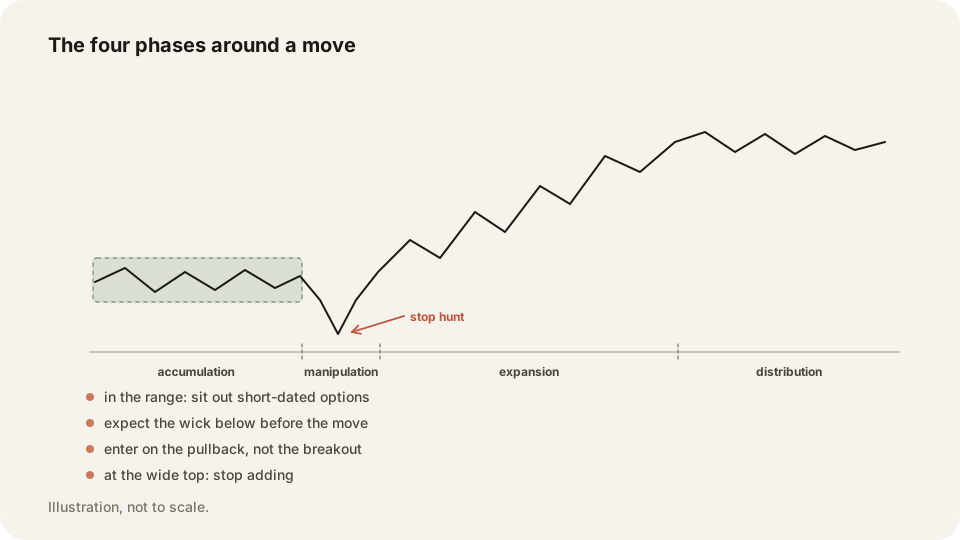
Manipulation: the wick past your level is doing a job
Manipulation is the misleading move right at your level. Large orders need someone on the other side, so weaker holders get pushed out first to supply that liquidity.
It runs in both directions. Price pokes below the support you just bought, clears the obvious stops, then turns. Or it spikes through resistance, collects the short stops, and rolls over.
This is why the exit rule is a close and never a wick. A candle closing beyond your level, on the timeframe you trade, is information. A wick that pokes through and pulls back is the mechanism working as designed. You are still in the trade.
It is the hardest rule to hold, because the wick arrives exactly when the position hurts most. Put your stop where a close would prove you wrong. Size so that distance is affordable, then let the wick happen.
Expansion: the pullback is the entry, the high is not
Expansion is the real move: higher highs and higher lows, or lower lows and lower highs. Sideways does not exist inside this phase, which is what makes it tradeable.
The entry belongs on the pullback, never on the candle that printed the new high. A full-bodied breakout candle gives you the direction and leaves you too far from your stop to be paid. Drop a timeframe and wait for the retest of the level that just broke.
Match the small cycle to the large one. Higher timeframes cycle slowly and lower ones cycle fast. An expansion on the five minute can be one pullback inside an hourly range. The hourly decides whether there is room.
One tension is worth naming. Wait too long for confirmation and the move has gone. A reversal is a pause rather than a round trip, so a second entry often never comes.
Distribution: stop adding and let volume answer
Distribution is the rebalance after an aggressive move, in either direction. A hard sell-off distributes to late sellers the same way a rally distributes to late buyers.
The instruction here is subtraction. Stop adding to the position. Take partials into strength while a solid candle still runs your way. Keep a runner if you want one. Freed capital is capital you can put somewhere better.
What happens next gets read off volume and candles, never off your preference. Continuation looks like heavy volume pushing through the last swing point. A reversal looks like long wicks and thinning participation at the same price.
Until one of those prints, you have no trade. Sitting through distribution because the move was good turns a winner into a scratch. One more candle turns the scratch into the day's loss.
Name the phase before you name the trade
One pass before the entry, done on the chart that gives you direction. Each answer sends you somewhere different, which is the only reason these labels are worth learning.
- Read the direction chart before you open the entry chart
- Ask whether price is ranging or making higher highs and higher lows
- Say accumulation, manipulation, expansion or distribution out loud
- In accumulation, draw the box from two touches on each side
- Copy the box forward and wait for a close outside it
- Target one box width from the edge that broke, and no more
- In manipulation, hold until a candle closes beyond your level
- In expansion, buy the pullback instead of the breakout candle
- In distribution, take partials and stop adding size
- Check how much expiry you bought before agreeing to sit and wait
- Write the phase in your journal next to the fill
Frequently asked questions
Accumulation, manipulation, expansion and distribution. Accumulation is the sideways build, manipulation the shakeout near a level, expansion the real move, distribution the rebalance afterwards.
A candle closes outside the range box you drew, ideally with volume behind it. Until that close prints, the range is still the range, however convincing the last candle looked.
Yes. Distribution follows any aggressive move, so it shows up after a hard drop as readily as after a rally. The tell is the same: participation thins while price stalls.
Name the phase in your TraderLog entry
Each day gets one journal entry in TraderLog, so write the phase you thought you were in. The calendar shows that day's profit and loss from your broker sync next to it. Weeks of that build a real record.
Every trading morning at 8:40 ET our model draws the SPY, QQQ and IWM zones it expects to matter, on a TradingView chart, before the open. Where price reaches one, it has turned 74 percent of the time. Free, no account. See today's map