Two touches a side, then stop looking for more
A range box is only worth drawing when price is genuinely sideways. Draw one across a trend and every edge is stale before you use it. This is the version that gives you a trade.
A box around a trend is just a rectangle
Range boxes belong in one place: sideways price, where both sides are building positions. Draw one across a trend and the edges are already behind price.
Check the direction chart before you draw anything. Higher highs with higher lows is expansion, and there is no box to draw in expansion.
The cost is worse on short dated options. Sitting inside a range on a same day expiry means decay charges rent while price does nothing for you.
The tell is usually in the touches themselves. If your top line clips three candles and your bottom line clips one, price is drifting. A range holds both edges roughly the same number of times.
Redraw it tomorrow, or accept that this is a trend and trade it as one. Forcing a box onto a trending chart gives you two lines that price walks straight through.
Two touches on top, two underneath, then stop
Mark two points where price turned down and two where it turned up. Connect the top pair, connect the bottom pair, and the box is drawn.
Wicks or bodies both work. Pick one and use it on both edges. Mixing them gives you a box that is wider on one side for no reason you can defend.
Then copy the box forward to the right so it sits over live price. Those two edges are the only prices you care about until one of them breaks.
Wicks give you the wider box. You get fewer false breaks and a later entry. Bodies give you the tighter box, more signals, and more of them fail. Pick the one that matches how much you can sit through.
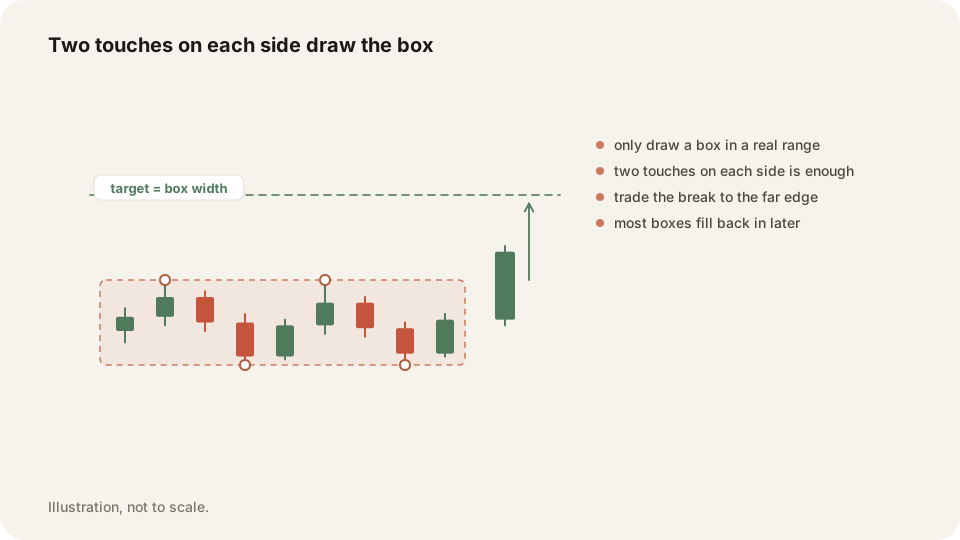
The target is one box width, then you are out
A range fills back in. Price leaves the box and runs about the width of the box. Then it comes back looking for the traders who chased it.
So measure the box and use the height as your target. A box from 98 to 100 is two points tall. A break above 100 targets 102.
Put the stop back inside the box, say a close below 99.60. Risk is 0.40 and reward is 2.00, which reads as five to one on the chart.
Take it off at 102. The box promises you nothing past that, and holding for more is how a paid trade turns into a scratch. If the move keeps going without you, that is a different trade with its own plan.
The break is a close, and a poke back inside is normal
Enter on a candle that closes outside the box on the timeframe you are trading. A wick outside is price checking, and it happens on the way to nothing.
The same rule protects you afterwards. A wick back inside the range is buyers or sellers being taken out, and it is expected. A close back inside says the break failed and the fill has started.
So one trigger runs both ends of the trade. Close outside to get in, close back inside to get out. Nothing about the option price enters that decision.
The hard part is watching the wick print while you sit there. That candle is doing its job. Traders who put a stop at the edge of the box are the liquidity the real move needs.
Waiting for a fifth touch costs you the break
More touches make a prettier box and a later entry. By the time the fourth and fifth touches print, the range is obvious to everyone watching it.
Two touches a side is enough to define an edge, and the edge is the part you trade. Extra touches add nothing to the price you would have used anyway.
There is a real trade-off. Two touches also produce boxes that never break cleanly, so you will draw some that go nowhere. Passing on those costs you nothing except screen time.
How flat sideways has to be is never defined by a number. You decide it, and the decision belongs in your notes so you can check it later against results.
One box a day is plenty. If you are drawing five, you are drawing rectangles around trends again.
The order to draw it in
Run this from the top every time. If the first line fails, there is no box and no trade.
- Confirm the direction chart shows sideways price before drawing.
- Mark two turns at the top and two at the bottom.
- Use wicks or bodies on both edges, never one of each.
- Extend the box to the right so it covers live price.
- Measure the height of the box and write it down.
- Set the target one box width beyond the edge that breaks.
- Put the stop back inside the box, past the broken edge.
- Wait for a candle close outside the box before you enter.
- Check reward is at least twice risk before you send it.
- Take the trade off at the target instead of holding for more.
- Delete the box once price starts making higher highs and higher lows.
Frequently asked questions
Two on top and two underneath. More touches make the box prettier and your entry later, which is a worse trade.
Either one, as long as you use the same on both edges. Wicks give a wider box and fewer false breaks.
One box width past the edge that broke. A two point box that breaks at 100 targets 102, and then you are flat.
Review your range breaks in TraderLog
TraderLog replays each imported trade on a TradingView chart with your entry and exit marked. You can see whether the box you drew held two touches a side. Write the answer in the day's journal entry.
Every trading morning at 8:40 ET our model draws the SPY, QQQ and IWM zones it expects to matter, on a TradingView chart, before the open. Where price reaches one, it has turned 74 percent of the time. Free, no account. See today's map