Right at 10:15 and paid at 2 p.m. is still a losing trade
The level held, the direction was correct, and the contract finished red anyway. On a same-day expiry the clock is the position you are holding. A time stop puts a limit on it.
You were right, and decay collected the difference
You bought calls at 10:04 because the level held and the candle confirmed it. Price then did nothing for thirty-five minutes. At 11:10 it broke exactly where you said it would. You had already closed for a small loss, and the direction was right the whole time.
On a same-day expiry, the clock is the position. Every minute the underlying spends deciding, your contract gives back extrinsic value. Near the money on expiration day, it gives it back quickly. Being early and being wrong produce the same line in your account.
This is how a correct read on a level still turns into a red trade for an options buyer. Right about direction, right about the level, and short of premium by the time the move lands.
Stock traders do not have this problem. Sitting through chop costs them opportunity. It costs you principal.
The five-candle time stop on a same-day expiry
On a zero-day expiry, give the trade five candles of your entry timeframe. No breakout by the close of the fifth and you are out, whatever the contract is priced at.
On a 5-minute entry that is twenty-five minutes. On a 2-minute entry it is ten. The number scales with your chart. The stop is measured in the same units as your decision.
Five candles is long enough to let the shake-out happen. Price often runs the wrong way first, takes the obvious stops, and comes back. A two-candle limit throws you out inside that. It is also short enough that decay has not taken the trade, so candle five still returns real premium.
What counts as a breakout has to be written down before entry, the same as your price stop. A close beyond the level with volume behind it counts. Drifting a few cents past does not.
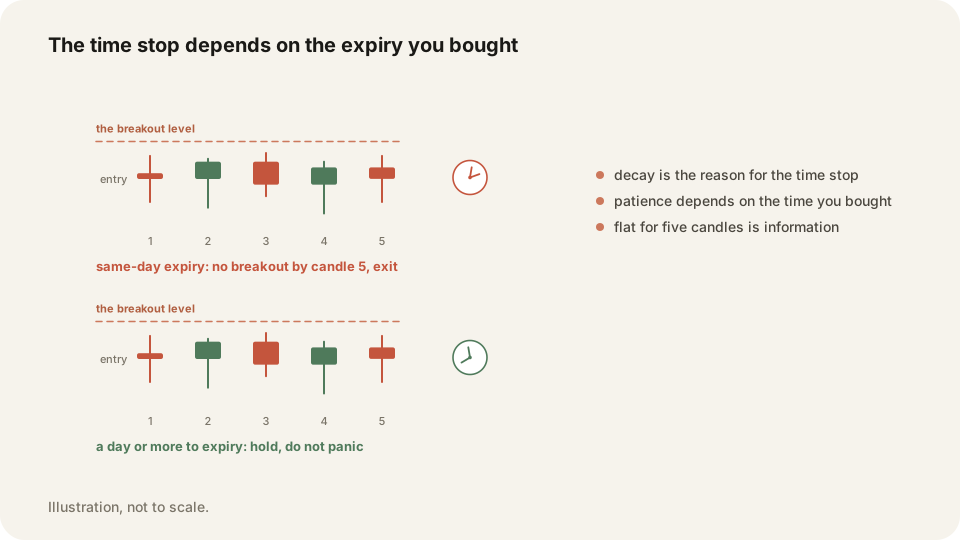
With a day or more left, the instruction reverses
Buy an expiry a day or more out and the five-candle stop stops applying. The correct instruction becomes the opposite one. Do not panic, hold the position, and give it until later in the session.
The reason is the same in both cases. Your patience is rationed by the time you bought. Zero days to expiry buys minutes of tolerance, a week buys sessions. Nothing about the level or the pattern changed, only the amount of decay you signed up for.
So the choice of expiry is really a decision about how long you are allowed to be wrong. Work out how long the setup needs, then pick the contract. Buying the cheapest one means finding out later.
The unresolved part, honestly: nobody can tell you exactly how far out to buy. It depends on how far the level sits from price and how much the day is moving.
Sideways is the worst place to hold short-dated premium
Markets spend a good part of the session going nowhere while positions are being built. That phase looks harmless on a chart. For a same-day contract it is the most expensive place you can be. You are paying rent on a decision the market has not made.
You can usually see it. Overlapping candles, small ranges, volume falling away, and price rotating inside a zone instead of leaving it. If your entry landed in the middle of that, the five-candle stop will fire, and firing is the correct outcome.
The matching entry rule saves you most of these. Get in as close to the level as you can. Distance from the level costs you twice on a zero-day expiry. It widens the stop, and price has to travel further before the move pays anything.
Waiting inside a zone is a position too. It just does not feel like one.
Log these fields to separate time losses from direction losses
Your account statement does not tell you why a trade lost. A handful of extra fields do. Record them at the exit while you still remember, and the pattern shows up within a couple of weeks.
- Record the entry time to the minute
- Record the exit time to the minute
- Record days to expiry at entry, zero included
- Record how many candles passed before you exited
- Tag whether direction eventually went your way
- Tag whether the exit was the price stop or the time stop
- Note the distance from your entry to the level
- Note whether the underlying was ranging or expanding
- Sort losing trades by days to expiry at the weekend
- Compare average hold time for winners and for losers
Frequently asked questions
A rule that closes the trade after a set number of candles when nothing has broken. The contract price does not change that. Five candles of your entry timeframe is a workable default.
No. Buying more time is what buys the patience. With a day or more to expiry, hold the level and give the trade until later in the session.
The move most likely arrived after your premium had decayed, or arrived too slowly to cover it. On a same-day expiry, extrinsic value drains through the session either way.
Check the hold-time stats in TraderLog
TraderLog groups results by how long trades were held, so quick exits sit apart from the rest. Same-day fills import from Schwab or IBKR automatically. The habit findings stay quiet until there are enough trades to say anything.
Every trading morning at 8:40 ET our model draws the SPY, QQQ and IWM zones it expects to matter, on a TradingView chart, before the open. Where price reaches one, it has turned 74 percent of the time. Free, no account. See today's map