Four lines written before entry, or you do not have a trade
You know what you are doing until the candle prints and you start improvising. A plan written before entry has four parts. If you cannot state all four, the setup is not ready.
Improvising looks like a plan while the trade is green
The plan you make after entry is written by someone who owns the position. That person is a poor analyst. Every number they pick gets negotiated with a live profit and loss.
In practice it looks like this. You spot a level on QQQ at 9:38 and the candle looks right. The move is starting without you. So you buy calls at 9:41, with no stop price and no target on the page.
At 9:46 the contract is down 18 percent. Now you are deciding whether that is noise, with the account already smaller. Whatever you choose, you cannot tell afterwards whether the idea was wrong or your reaction was.
A written plan fixes one thing. It moves every decision to a moment when you have nothing at stake. That is the whole mechanism. Four fields, filled in before the order goes in, make the trade gradeable later.
The four parts you write before you click
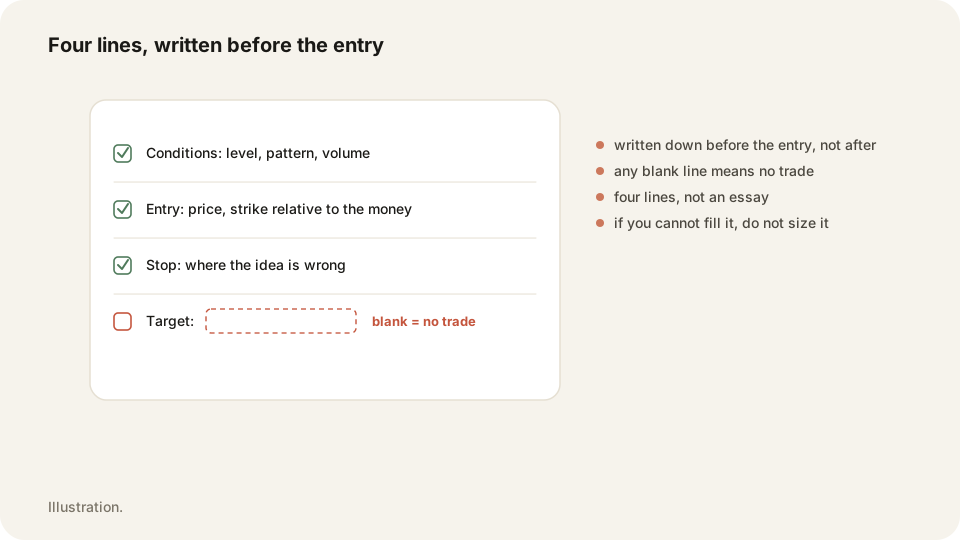
Conditions: what has to be true for this trade to exist. Name the level, the candlestick pattern that formed at it, and whether volume showed up on the reaction. If you cannot point at all three, you are looking at a chart rather than a setup.
Entry: the exact price you will pay, and for options the exact contract. Which expiry, which strike, how far in or out of the money. Buy calls is not an entry.
Stop: the price at which you are wrong. Write it as a level and a trigger, for example a 5-minute close below 512.40. Decide it now, because you will never like it later.
Target: where you are taking it off, read from the chart rather than from what you would like to make. It has to be a place price could realistically reach, usually the next zone. If the answer to any of the four is we will see, close the platform and wait.
A blank field is the most useful thing on the page
When you cannot fill in the stop, the real problem is usually that you cannot find the level. The blank field is the setup telling you it is not clean enough to trade.
The four fields make the trade falsifiable before it exists. You have written down, in advance, what would prove you wrong and what would prove you right. Every entry after that is a claim with a receipt attached.
This also kills two expensive habits. You cannot move a stop you already published to yourself without noticing you did it. And you cannot claim afterwards that you always planned to hold longer. The target is sitting there in your own handwriting.
The plan will not make you right more often. It makes the record honest, which is the thing that lets you improve the plan.
Grade the plan and the outcome as two separate scores
A losing trade with all four fields filled and followed is a good trade. A winning trade you improvised is a warning. Track profit and loss alone and those two get the same score, so you learn the wrong lesson from both.
Keep two columns in your journal. One is the result in R, the multiple of your planned risk. The other is a plan grade: did you write all four fields, and did you follow them?
After twenty or thirty trades you can sort by grade rather than by result. Followed plans that lose money point at the plan. Broken plans that made money point at you. The second group is the dangerous one, because the money rewards the habit and you repeat it.
The four-field template to paste into your journal
Copy this into a note and fill it in before every entry. It should take under a minute once the fields are familiar. If one is still empty when you finish, you have saved yourself a trade.
- Name the level and the timeframe you found it on
- Name the candlestick pattern that formed at the level
- Note whether volume expanded on the reaction
- Write the exact entry price you will pay
- Write the expiry, the strike, and how far from the money
- Write the stop price and the close that triggers it
- Write the target as a price on the chart
- Check the target pays at least twice the risk
- Note position size and what that risks in dollars
- After the exit, grade the plan separately from the result
Frequently asked questions
Under a minute once you have a template. If it takes much longer, the setup is usually not clean, and the delay is doing its job.
Then it is a different trade. Write the four fields again for the new picture, or let it go. Editing a plan mid-entry is improvising with extra steps.
Yes, and it fits on one line: level, entry, stop, target. How fast the trade runs does not change how the decision gets made.
Write the four lines in TraderLog
The day's entry is free text, so conditions, entry, stop and target can go in before the open. The checklist has a fixed item for trading plan executed. The calendar shows an adherence score for the day.
Every trading morning at 8:40 ET our model draws the SPY, QQQ and IWM zones it expects to matter, on a TradingView chart, before the open. Where price reaches one, it has turned 74 percent of the time. Free, no account. See today's map