Where your disallowed losses actually went
You traded the same three tickers all year. The 1099-B lands with a column of disallowed losses. Almost all of that money comes back to you. The version that costs real money is the one you carry into January.
A wash sale moves your loss into the next position's cost basis
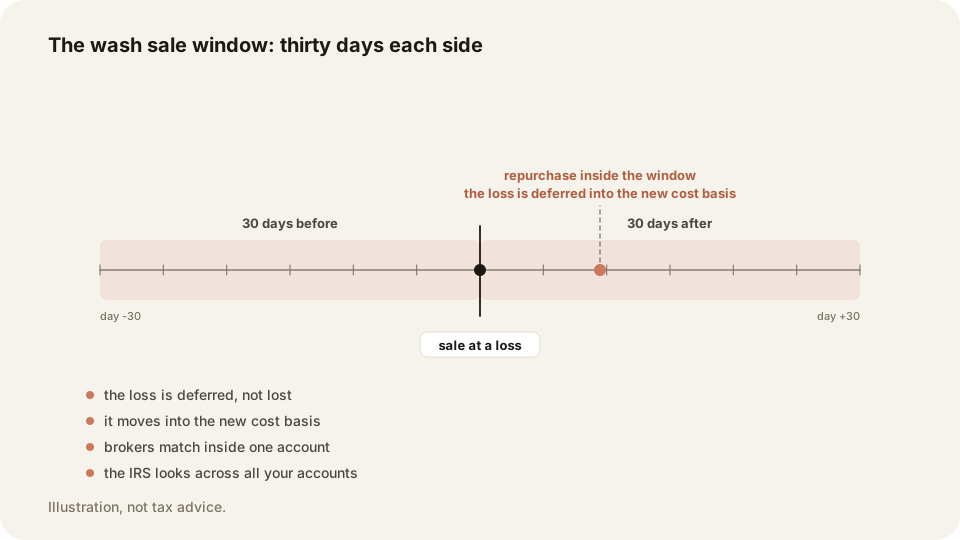
A wash sale happens when you sell at a loss, then buy a substantially identical position within 30 days. The window is 61 days wide in total: the 30 days before, the sale itself, the 30 days after. Both sides count, which catches people who only look forward.
The loss on that sale is disallowed. The same amount is added to the replacement position's cost basis. Buy back at 50 carrying a 3 dollar disallowed loss and your basis becomes 53. When you finally close that position and stay out, the deferred loss comes through.
Substantially identical covers the same stock, and options to buy the same stock can count too. A different company in the same sector does not.
Active traders trip this rule almost every week
Trading a short list of names repeatedly is what sets it off. Scalp one index ETF for a living and nearly every losing exit has a replacement inside 30 days. You are back in the ticker tomorrow morning.
Inside a single year that mostly comes out in the wash, which is where the name comes from. A loss disallowed in March folds into the basis of the April position. Close that one and the deduction arrives late rather than never.
What ends a chain is being flat. Sell the last replacement and stay out of the name for 31 days. The deferred losses land in the year of that final sale. The chain does not end because the calendar turned over.
Holding a tainted position past December 31 creates the tax bill
Carrying a wash-sale-tainted position into the new year is the version that produces a bill bigger than your profit. The disallowed losses sit in the basis of a position you still hold. They do not reduce this year's income. Every gain you realised does.
The arithmetic is the ugly part. Suppose you realised 90,000 in gains and 85,000 in losses, so you actually made 5,000 on the year. If 60,000 of those losses are disallowed and locked in an open position, your reported gain is 65,000. You owe tax on money you no longer have in the account.
Closing the chain and staying out of the name through the end of December is what avoids it. Work out which names carry disallowed losses in November, not in April.
Your broker matches fewer wash sales than the IRS does
Brokers match wash sales within one account and one exact security. That is what the reporting rules require of them, and it is what your 1099-B reflects.
The rule you are taxed under is wider. The IRS applies it across every account you control. Sell at a loss in your taxable account. Buy the same stock in your IRA inside the window and it counts. The IRA version is the worst case. That disallowed loss never lands in a basis you can use.
So two brokerage accounts trading the same names produce a 1099-B that understates the problem. A taxable account plus a retirement account does the same. Reconciling that across accounts is your job, and nobody sends you a reminder.
The 475(f) election takes qualifying traders out of the rule
Traders who qualify for trader tax status can make a Section 475(f) mark-to-market election. Under it, open positions are treated as sold at year end at market value. Trading gains and losses become ordinary. Wash sale rules stop applying to the trading business.
It also removes the 3,000 dollar annual cap on deducting net capital losses against other income. A trader with a bad year can take the whole loss that year. No more 3,000 at a time for a decade.
The timing is what catches people. For an existing individual taxpayer, the election is filed by the unextended due date of the prior year's return. You commit to a year before you know how it goes. Qualifying for trader tax status has its own tests around frequency, volume and intent. Talk to a tax professional before you file anything.
Work through this before the year closes
Run it in November, while you still have time to act on what it finds.
- Tag every closed trade in your journal with the ticker and the exit date.
- List the names you closed at a loss during the last 30 days of the year.
- Check whether you hold an open position in any of those names on December 31.
- Close the chain and stay out 31 days if you want the deduction this year.
- Check your IRA and any second brokerage account for repurchases of the same names.
- Never repurchase a name in an IRA within 30 days of a taxable loss in it.
- Compare your own realised P&L against the disallowed loss column on the 1099-B.
- Add each disallowed amount to the replacement position's basis in your own records.
- Diarise the 475(f) filing deadline now if you plan to elect for next year.
- Keep December's trades in one view so the year-end review takes minutes.
Frequently asked questions
Much less. Stay out of every name for the last 31 days of the year and the chains close. The deferred losses land in that year. The disallowed amounts still show on the 1099-B, but they resolve.
Yes. Options to acquire the same stock can be substantially identical, and repeatedly trading one option series creates the same deferral. Section 1256 contracts, including index futures, follow different rules.
No. Brokers report per account and per exact security. Combining accounts, including your IRA, is on you at tax time.
Keep the full year of fills in TraderLog
TraderLog does no tax work, and it will not tell you about disallowed losses. What it keeps is every fill from Schwab, IBKR or a CSV, dated, with the day's P&L. Your accountant still works from the broker's own forms.
Every trading morning at 8:40 ET our model draws the SPY, QQQ and IWM zones it expects to matter, on a TradingView chart, before the open. Where price reaches one, it has turned 74 percent of the time. Free, no account. See today's map