Twenty small winners, two losses that erase them
Your winners get closed at plus 0.3R while your losers get room until they hurt. The habit has a name and a shape you can see in your own numbers. What follows is mechanical rules rather than another lecture about discipline.
Closing a winner feels like safety, so you do it early
You take the winner because the profit is real right now and it might disappear. You hold the loser because closing it makes the loss real. Same trader, two opposite rules, and the market charges you for both.
Behavioural finance calls this the disposition effect, a pull toward banking gains and postponing losses. You can watch it happen on your own screen. Plus 40 dollars at 10:14 gets taken because the candle stalled. Minus 40 dollars at 10:41 gets a little more room because the level is close.
The awkward part is that both decisions felt sensible at the time. Neither one came from the plan you wrote before the open. That is why willpower alone rarely repairs this. The rule has to be written down before you are in the position.
The shape it makes in your R multiples
R is the result of a trade divided by the risk you took on it. Risk 200 dollars and make 200 dollars, that is plus 1R.
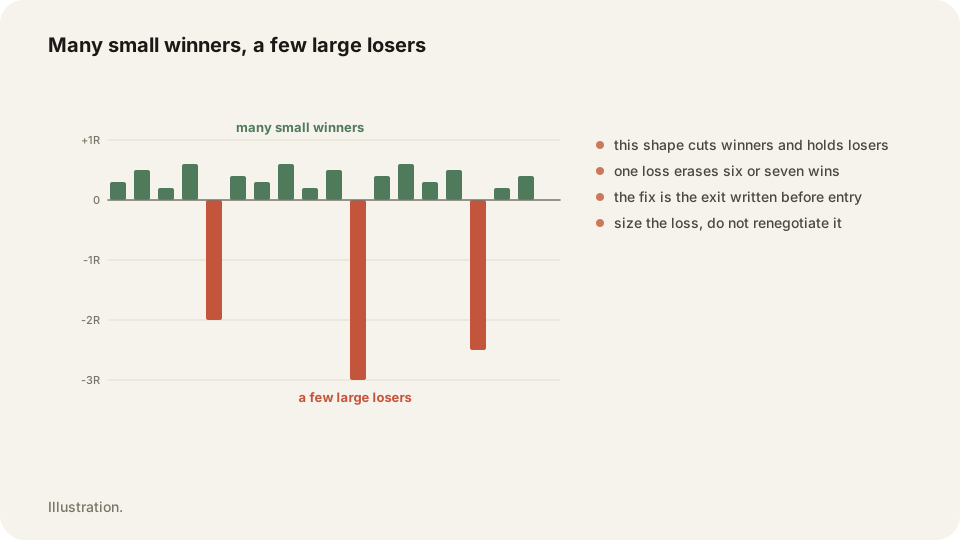
A trader with this habit has a very recognisable distribution. A crowd of small winners between plus 0.2R and plus 0.5R. A wall of losses at minus 1R. Then a few stragglers out at minus 2R or worse, which are the trades where the stop got moved.
Add a block up and the arithmetic finishes the story. Twenty winners at plus 0.4R gives plus 8R. Ten losers at minus 1R and two at minus 2.5R gives minus 15R. That block was 62.5 percent winners and lost 7R.
Nothing in there is a bad entry. Every one of those trades was found correctly and then handled backwards on the way out.
Write the exit before you take the entry
Four rules cover almost all of this. Each one is checkable after the fact.
First, the target goes in the journal before the fill, in price and in R. If you cannot state a target and a stop, you have a chart you like rather than a trade. Second, the stop is a resting order placed with the entry, and it is never widened. Widening is what turns minus 1R into minus 2.5R.
Third, take partials at a level you decided in advance and leave a runner for the full target. That gives you the relief of banking something without paying for it with the whole position. Fourth, when price has held in your favour for a few candles, move the stop toward breakeven. Moving it beats closing the position.
Run those four for a month. The distribution changes shape before your entries change at all.
Two comparisons that expose it in five minutes
Both use numbers you already have. Both need the plan recorded at entry.
Compare your average winner in R against your average planned target in R. Say your plans called for 2R and your winners average 0.6R. You are collecting under a third of the plan. That gap is the exit problem, measured.
Now compare your average loser in R against 1R. If the plans all said 1R and the average loser is 1.4R, stops moved on roughly four trades in ten. No memory needed, the number tells you.
Do this per setup tag rather than across the whole account. Traders often hold breakout runners perfectly well and choke every mean reversion trade at plus 0.3R. Blended together, the two cancel out and you learn nothing.
The pre-trade card to fill in every time
Ten fields, written before the entry goes in. Anything you cannot answer is a reason to pass.
- Write the entry price and the reason it is that price.
- Write the stop price and what would have to happen to reach it.
- Write the target price and the level it is measured to.
- Convert the target into R and check it is at least 2R.
- Place the stop as a resting order at the same time as the entry.
- Decide the partial level now and how many shares come off there.
- Decide the number of candles in your favour that allows a move to breakeven.
- Tag the trade with its setup name before the market moves.
- After the exit, log realised R next to planned R in the same row.
- Review the two columns weekly and count every row where the stop moved.
Frequently asked questions
No, provided the partial level was decided before entry and the runner keeps the original target. It becomes cutting early when you take the partial because the trade wobbled.
Place it as a resting order with the entry and allow it to move in one direction only, toward breakeven. Then count the exceptions in your journal each week.
It helps on the winner side and does nothing on the loser side. Trailing stops still let you widen the initial stop, which is where the damage comes from.
Let TraderLog time your winners and losers
The habit findings are statistical, not opinion. One of them speaks up when your losers are held longer than your winners. The stats page puts average winner beside average loser, and groups results by how long you held.
Every trading morning at 8:40 ET our model draws the SPY, QQQ and IWM zones it expects to matter, on a TradingView chart, before the open. Where price reaches one, it has turned 74 percent of the time. Free, no account. See today's map